
Hamnet, Femininity, and Saving the World
On the war in Iran and making the world a garden

I have been writing and podcasting as Inner Emigre for one year. Thank you for reading and listening and sharing. Please consider becoming a paid subscriber to support the work.
“Every creature is a glittering, glistening mirror of divinity.” – St. Hildegard of Bingen
On Feb. 28th, the Trump administration launched an illegal (not approved by Congress) and unjust war in Iran. The war is costing the American people a billion dollars a day while it enriches the Trump family. The President’s sons are backing a drone company, as Chinese drones have been banned by their dad. The war began with the US bombing a girl’s primary school in Iran. 175 schoolgirls and their teachers were murdered, and our President couldn’t even be bothered to give a boilerplate apology. I have no illusions about the rectitude of the Iranian leaders. But you can hold two things to be true at the same time. The Iranian regime is evil (most recently killing tens of thousands of its own citizens for protesting), and the war is wrong.
Here’s what I do know. This war is making the Trump family rich. The US started the war on behalf of Israel, a foreign nation, and it is, at least in part, a distraction from the administration’s many crimes. Including, but not limited to, Kristi Noem handing out 220 million dollars of corrupt contracts to cronies for ads, starring herself, for DHS, and Trump being accused in the Epstein Files of the rape of a 13 year-old.
Despite promising no more regime-change forever wars in the Middle East, the administration has not ruled out sending in troops, instituting a draft, or the use of nuclear weapons.
And yet life goes on as it must. We go with the kids to Grandma and Granddaddy’s house for lasagna. I tell my 7-year-old that he must eat at least two green beans. I volunteer at my kid’s school and realize I could never teach elementary, as I am so overstimulated by the end of the day that when I get home, I need to lie down. I take a walk in the snow with my schizophrenic nephew, and the snow and makes us both happy. I do female-coded things. I water the plants, cook dinner, do laundry, plan kid birthday parties, and have movie nights. And I think of the war in Iran and am reminded of C.S. Lewis who wrote, “If we are going to be destroyed by an atomic bomb, let that bomb, when it comes, find us doing sensible and human things -- praying, working, teaching, reading, listening to music, bathing the children, playing tennis, chatting to our friends over a pint and a game of darts -- not huddled together like frightened sheep and thinking about bombs.”
I am trying to stay sensible.
In my household we watch a movie together almost every week. It’s a ritual. The movies we watch have become a reference point for all of us, like a core curriculum. The other night, my teenager said of The Lord of the Rings at dinner, “Who would take hobbits on that kind of a journey?” And my 7-year-old yelled from the bathroom, “Because Hobbits don’t get tempted by the power of the ring!!” They don’t.
I am trying to stay human.
Recently, we watched Hamnet. (We had to fast forward in a few places, but we watched it, the five of us, all the way through.) I used to direct Shakespeare and at the end I was in tears. My youngest crawled into my lap and hugged me while I cried.
In my last essay I wrote about masculinity and saving the world. Hamnet forcefully and beautifully reminded me of femininity, and also of saving the world.
Hamnet was directed by Chloe Zhao, who co-wrote the screenplay with Maggie O’Farell based on O’Farrell’s novel of the same name. Zhao and O’Farrell imagine the life of Shakespeare’s wife, Agnes, played by the brilliant Jessie Buckley. Buckley’s performance makes the film. (Spoilers coming for those who have not seen the film and want to be surprised.)
Agnes is a strong and mystical figure. She is the kind of woman some weak men fear.
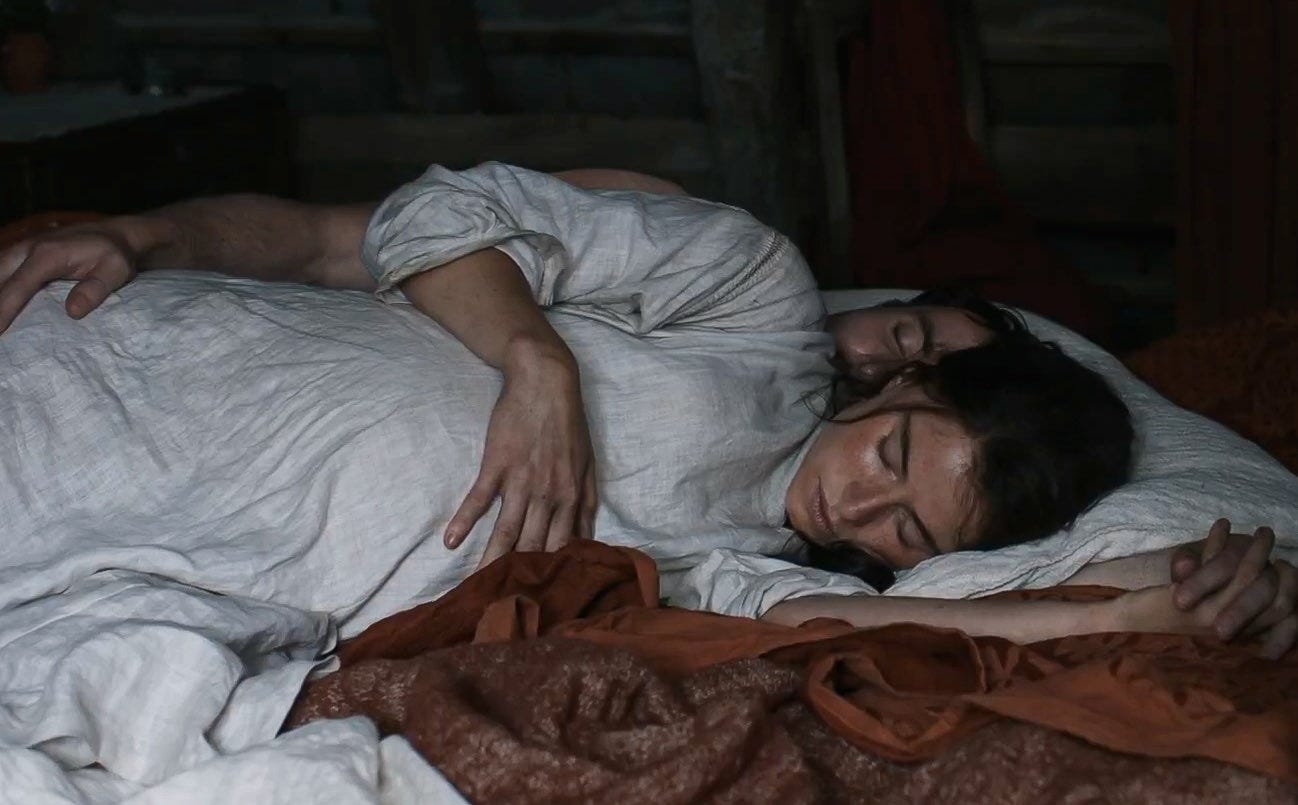
She embodies many of the female archetypes described by Carl Jung. Jung’s archetypes are universal. They appear in the folk tales of all cultures and so have entered what Jung called the collective unconscious. The female archetypes Agnes most embodies (mystic, mother, and muse) are often looked down upon by men and women alike, to our detriment, because each plays an essential role in creating the kind of world we actually want to live in.
First, Agnes is Mother. Someone who finds her purpose in nourishing and protecting life. In Hamnet, we see her give birth in a forest. It’s very realistic. We see her, when one of her twins is born not breathing, whispering over the child, “You shall live.” We see her working round the clock to keep that promise when the child is sick with “the pestilence.” We see Agnes teaching, loving, and fiercely protecting her children. She rearranges her life around their needs. In our society, we see this as weakness. It is not weak at all. It is heroic.
When her son dies, Agnes wails in agony. Her cry is the cry of every human parent who has lost a child. A universal cry.
The mostly men who run the world want us to numb out. They do not want us to wail when children die. But Agnes wails. She grieves. She rages at her son’s passing. She feels it all. The beauty of his life and the pain of his leaving.
Many of us have heard that women and feminine people are “too emotional.” Many boys and men were taught to hide their emotions (with the exception of anger) so as to appear less feminine or gay. But emotions are a form of intelligence. If someone cannot read or express emotions, we say they have a disability. Indeed, this President and his cabinet dropping bombs that land on schoolchildren and then doubling down, bragging about the larger waves of bombings to come, makes them seems unwell.
In Hamnet, Agnes shows us the value of one human life and, by extension, the value of all. She says of her son who died, “I would have cut my own heart out and given it to him.” And we believe her, such is the strength of the Mother.
Agnes also embodies the archetype of the Muse (someone who finds purpose in romantic relationships). Agnes chooses Will. She places his hand on her before their first kiss. And she keeps choosing him even when he is lost. She fights for his genius, gaining permission for him to go to London to work in the theater. She makes him better. Women often do this. Helpers and muses are devalued. Better to be the guy, than the guy behind the guy. But the world needs them too. Every artist, every genius, is able to do what they do because somebody loved them.
Agnes is powerful and difficult to control because she is so connected to her body, to nature, and to the Otherworld, no less real for being unseen. Seeing how connected she was to her own intuition I was aware of how much we have lost as a culture.
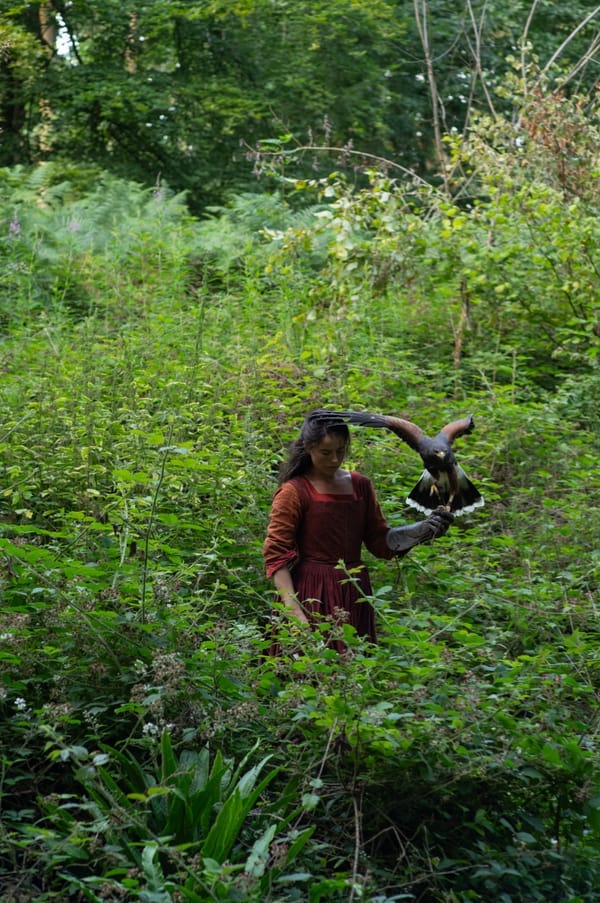
Because Agnes also embodies the Medial Woman or Mystic as described by Jung. She can hold the hand of someone she loves, pressing between their forefinger and thumb, and “see” things. She is also connected to the land, the plants, and the animals near her home. In the first scene we see her hunting in the forest with her hawk. And in another helping her brother understand what is happening with his bees. Because a woman with such gifts is often feared, she is derogatorily called a “forest witch” by her sister-in-law.
Both the left and the right often use “old white woman” as a put-down. They might as well just say “witch.” The women protesting on the streets of Minneapolis were called “old white ladies.” Seen as wrong, not just because of their opinions, but because of their bodies. The hierarchy that masculine is better than feminine remains. You see it in our language, and in how women and men in touch with their femininity are often mocked. I know this. I have a daughter who excels at many masculine-coded things (like woodworking and sports). She is always praised by adults for this. I also have a son who has expressed interest in some feminine-coded things like design, and adults have told me “He will be bullied.” Or, “His life will be harder.” Why?
The world doesn’t just need business people, it also needs teachers and grandparents and nurses and mystics.
Don’t misunderstand. I love nothing more than watching women excel in domains previously forbidden to them. Jung calls this female archetype “The Amazon.” And yet, it seems to me that any feminism is incomplete if it values people by how “masculine” they are.
I want my own children to understand that women can be both badass and tender. So I tell them stories. Stories about Lynn Hill, the first rock climber, male or female, to free “the Nose,” a 3,000-foot 31-pitch big wall in Yosemite. I want them to admire her, as I do. But I also want them to admire the ancestor I am named after, who travelled across the Great Plains in a covered wagon with her family. I want them to admire that she and the other women travelled to a new land with seeds. They had no idea what they would find when they got to Texas or Oklahoma but they knew it would be improved by flowers.
Feminine people know that the world is meant to be both nursery and garden. You don’t have to be physically female, or even a mother, to be in touch with or to have this world mothering energy. You don’t have to be female to go out in the streets and say, “Stop killing children.” But it helps.
Hamnet tells the story of one family and their love. Agnes had a rich life. A life worthy of a movie. A life no less interesting than her husband’s. She knew a soulmate kind of love. She knew the names of plants and how to use them. She understood how to grow things and how to stay connected to the living and the dead. People like her have physical and moral courage.
As such, they won’t be satisfied with lies. There’s a scene when Agnes tells the sister-in-law who once called her a forest witch, “Don’t pretend to care for me.” It’s powerful because it’s true.
The mad king wants us to believe his lies, or else to get tired and numb out. The oligarchs want us on drugs that take the edge off. They want us at meaningless jobs so we can make and buy more. They want us helpless, unable to really do anything except passively consume. They destroy what is most precious of all and sell us “relationships” with AI chatbots. They want us sexless, placeless, godless, powerless, and utterly resigned.
People in touch with the feminine are not resigned. Think of mother animals in nature protecting their young. They are dangerous. Think of the tens of thousands of Iranian women (and men) who took to the streets to protest their own religious dictatorship. They took off their hijabs to defy the morality police. Tens of thousands of protestors were murdered. This, I think, is the femininity that will save the world. It’s moral and physical courage. It is the women in Minneapolis who came outside to protest in -23 degree weather. Who stood among the houses of those in hiding and sang.
Good men provide, protect, and make the world more beautiful. Good women do that too.
We have all of us devalued “women’s work” because it is so rarely well paid, but in Hamnet we see that women, though poor, have never been weak. We used to know how to midwife babies, and grow our own food, how to hunt, and care for our sick, to prepare bodies for burial, and communicate with god, and sew our own things. Not weak at all. The trad-wives, god bless them, are responding to something that has indeed been lost. A sense of mastery. Because so many of us no longer have the nerve to do much of anything. Without our technology what can we actually do?
In the film, after Hamnet’s death Agnes sends Will away to London. Heartbroken, he writes a story, based in part on his own story, called “The Tragedy of Hamlet”. And when Agnes goes to see the play, her son is brought back to life for her through the performance, and something in her is healed. Art is healing.
Speaking of femininity, it is safe to say that Will is not a traditionally “manly man.” He hates the trades; he would make a lousy shipbuilder or soldier. He is a poet. And Agnes loves him as he is. Bless her.
It hurts to love the world right now, to keep planting gardens, writing stories, and braiding children’s hair. It feels small. It is not. Shakespeare wrote a play. Maggie O’Farrell wrote a novel about it, and Chloe Zao turned it into a film. We are still not over it. Making the world more beautiful and more human is an end in itself.
It seems to me that watching movies as a family, and singing children sleep songs is a good use of one’s life. And it changes you if you let it. It makes it such that you cannot abide the bombing or imprisonment of children. We must value and connect with our masculine and feminine qualities. In our consumeristic world we think of being feminine as a list of merely physical attributes. Things you can buy: big boobs, big lips, big eyelashes, sparkly nails. But in a deeper sense, I think to be feminine means to be a protector of the land and its children. What do you think?
See you all at No Kings March 28th.
Anna, I am so moved by your clear articulation of virtues judged to be feminine, the identification of different ways to be good and to be brave along with the clear rejection of placing certain ways as superiors to other. It highlights for me that a true feminism values all of these virtues and strives to build a world where they are all valued, and all available to folks independent of gender. And that means BOTH breaking down the barriers keeping women from being allowed to embody ‘masculine’ virtues and building a society that respects (with money even!!) the work of the feminine.
Also I have resisted watching Hamnet because I know it will just wreck me. The book was only just survivable, probably because I could decide the pace myself. Maybe I can watch it on a spring afternoon when sunshine and a walk in the woods can be a palate cleanser.
Your words are always powerful and poignant. Thank you.